

SolidOcean is a free and open-source finite element modelling tool for calculating and analysing phonon dispersion relations, mechanical waves, and heat transfer problems.
Essentially, it is a Qt user interface uniting several open-source tools for creating meshes (with the Gmsh mesher), solving differential equations with boundary conditions (with the MUMPS solver), and analysing the results (with Matplotlib). Every model is a simple human-readable TOML file that can also be run headless from the command line, making it ideal for scripting and working with agents.
Documentation: anufrievroman.gitbook.io/solidocean
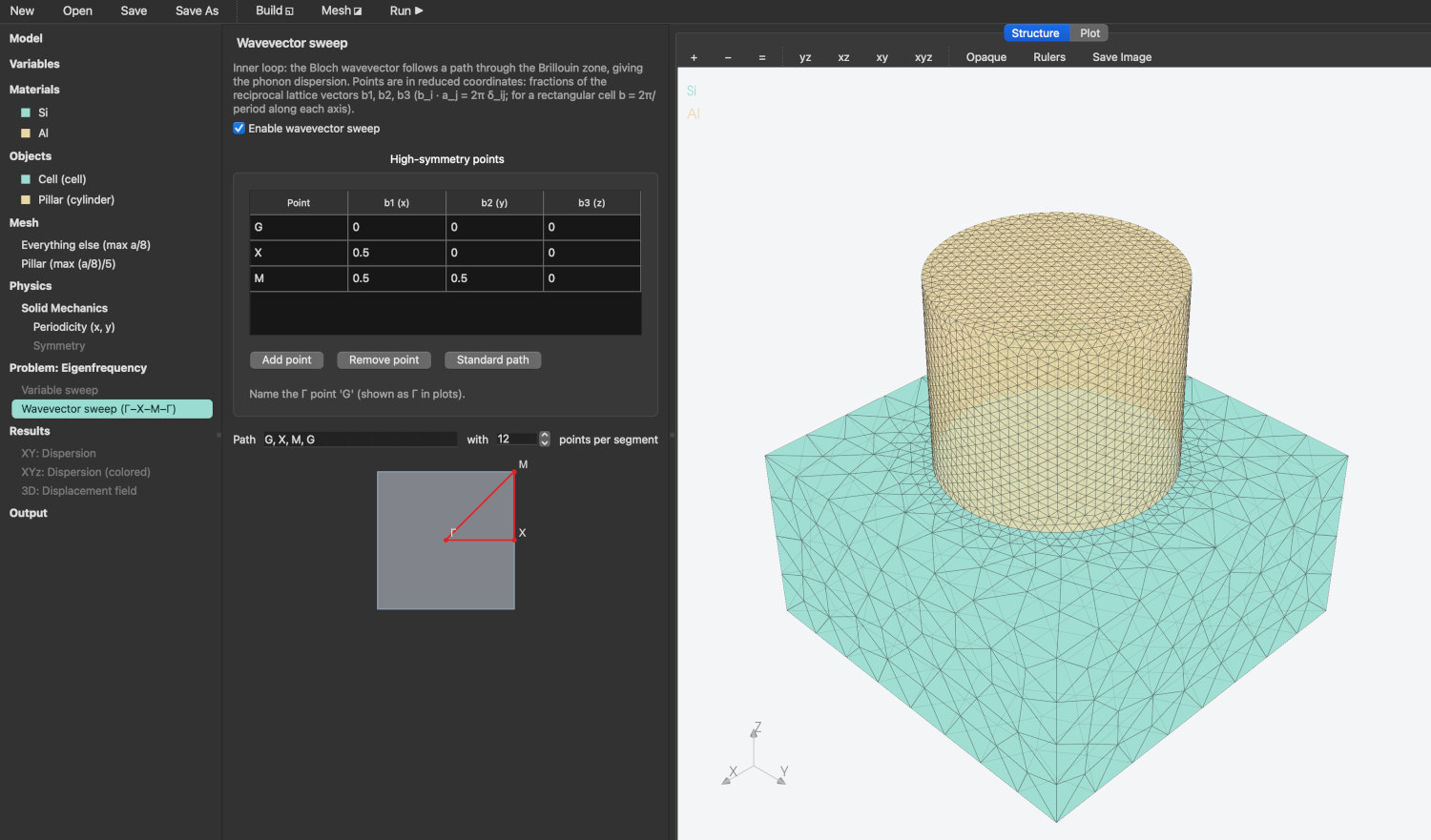
Solid mechanics problems
- Eigenfrequencies and mode shapes calculations with phonon dispersion along chosen wavevector paths in selected Brillouin zones.
- Stationary displacement calculation with strain, stress and von Mises stress under fixed or prescribed displacements and boundary loads.
- Frequency domain problems with the driven response to oscillating loads or displacements, with loss factors and absorbing regions.
- Coherent heat conduction at low temperature: the phonon bands over a mesh of the Brillouin zone, the density of states, group velocity and spectral heat flux they carry, and the ballistic thermal conductance that follows from them.
Heat transfer problems
- Stationary and transient problems with fixed temperature, heat flux, convection and radiation boundaries, volume heat sources with pulses and spatial profiles, thermal boundary resistances and thin resistive layers at interfaces.
- Frequency domain problems with the temperature oscillation driven at one frequency, as in the 3ω and FDTR methods.
- Hydrodynamic phonon heat transport (steady Guyer–Krumhansl equation): the heat flux is solved together with the temperature, giving Poiseuille flow in narrow structures and heat vortices beside current contacts.
The formalism pages describe the equations, elements and solvers, and the tutorials walk through example models.
Install conda, which will install all python dependencies.
Run these two command in a terminal:
conda create -n solidocean -c conda-forge solidocean
conda activate solidoceanLaunch using icon or by running solidocean in the terminal. First launch is slow, after that it's faster.
See Installation for more details.
Run solidocean to open the interface, or solidocean model.toml to run a model headless. The
Usage page covers the command line, the interface and the
files a run writes, and the Model file reference
describes every section and key of a model.
SolidOcean is compared with exact solutions of elasticity and heat conduction, including mesh and time-step
convergence. See Validation for the summary and the
full report. The code tests run with pytest; the validation suite with python validation/run.py
(see Testing and validation).
How the code is organised, and how to add a physics, is described in Architecture.
SolidOcean is an independent project, it is a graphical interface to existing open-source tools and it unites their workflow under one roof, meant to be used as a lab tool for academic research. It is provided as is, without any warranty. Although the core physics was validated, it may still contain bugs or be inappropriate for your research problem, so check the results of your models against known solutions before relying on them.
Copyright (C) 2026 Anufriev Roman. SolidOcean is free software under the GNU General Public License v3.0 or later. It builds on Gmsh, MUMPS, NumPy, SciPy, Matplotlib, Qt for Python, PyVista and VTK, each under its own license; see Licenses for the full statements.