

The process the operator runs to open the Knuckles agent platform.
MCP · REST · A2A · identity policy · fleet supervision · hosted interfaces













Documentation · Capabilities · Interfaces · Status
Run Arbora when an MCP client, HTTP application, A2A peer, or hosted interface needs one authenticated way into the platform. One serving lifecycle composes the same application services across transports, applies identity and tenant policy, and keeps tool discovery tied to the live fleet catalog.
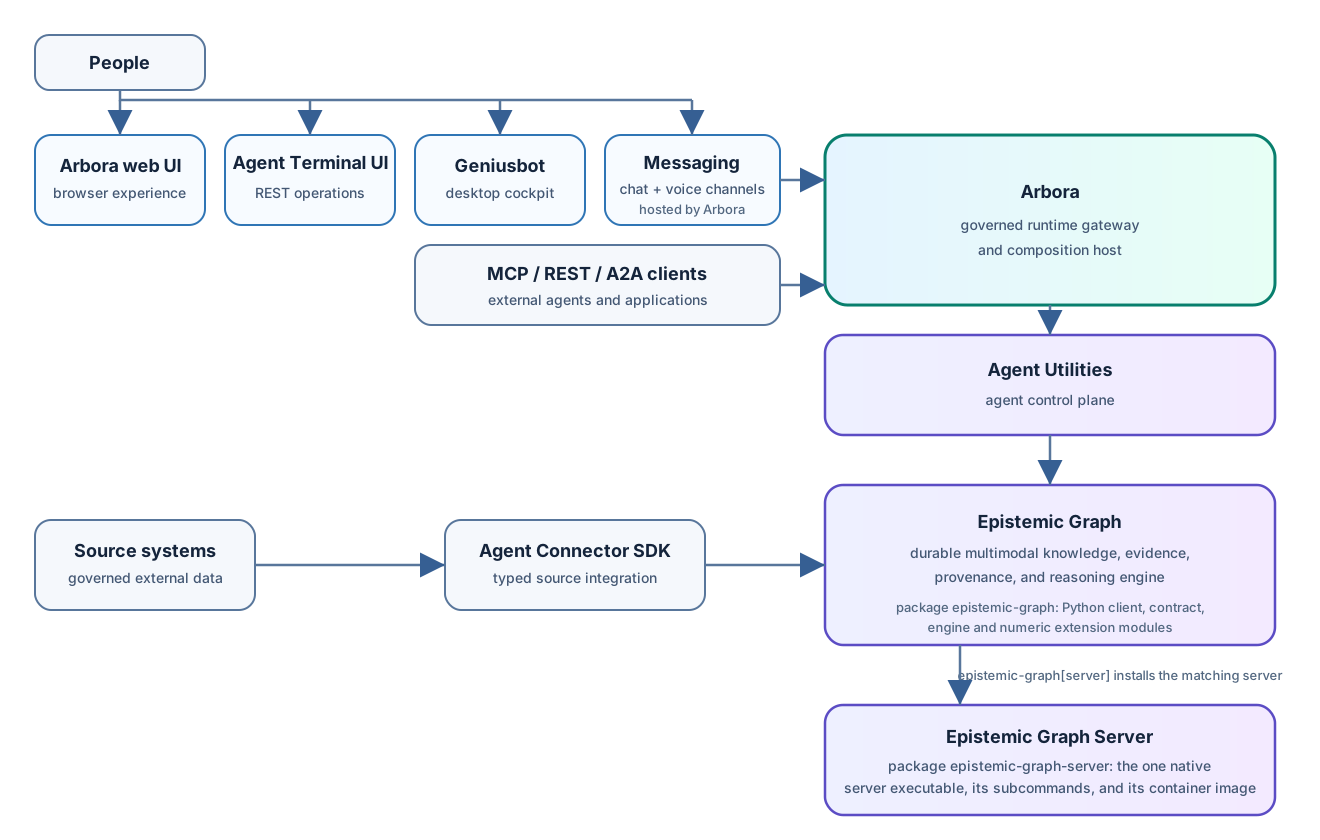
Arbora is the platform edge and composition root. It is not the agent harness, the durable database, a connector implementation, or the browser UI.
- Serve local MCP over
stdioand authenticated MCP over streamable HTTP. - Project the same governed operations through REST and unary A2A.
- Discover, admit, supervise, and route the MCP connector fleet.
- Apply identity, tenant, action-policy, idempotency, and provenance controls.
- Host Overstory and coordinate terminal, desktop, messaging, and attended browser capabilities.
- Generate deployment configuration and report live readiness through
/health.
Start with the visual platform guide, then use the task-oriented references:
- Start Arbora
- Review capabilities
- Choose an interface
- Understand the architecture
- Check live status
- Configure a deployment
| Layer | Authority | Relationship to Arbora |
|---|---|---|
| Overstory | Browser experience and local interaction state | Arbora hosts it and supplies governed application routes. |
| Tuig | Terminal and headless interaction | Uses the governed Arbora REST interface. |
| Axil | Desktop GUI | Uses the governed Arbora gateway for its primary panels. |
| Messaging channels | Chat and voice entrypoints | Arbora hosts and supervises them; Meristem holds no adapters or routing. |
| Arbora | MCP, REST, A2A, identity policy, fleet supervision | The running process and public door. |
| Meristem | In-run execution harness | Applies decisions it receives from Arbora. Holds no store and serves no MCP, API, or A2A. |
| Medulla | Durable graph, SQL, RDF, vector, time, reasoning, and provenance | Arbora uses a hand-written client tested on round-trip vectors. One engine, no synced second database. |
| Scion SDK | Connector contracts and transports | Arbora admits and routes SDK-based connector services. External stores stay connector sources, read as virtual graphs. |
The boundary is deliberate: Arbora authenticates, composes, routes, supervises, and projects. Each sibling remains the source of truth for its own domain.
Requires Python 3.12–3.14 and uv. Install the
bundled runtime and generate the local profile:
uv tool install "arbora[overstory]"
setup-config generate --profile tiny
setup-config doctor --profile tiny
The doctor command is the first observable result: it reports whether the local profile and required authorities are ready before a listener starts. MCP clients can start the local transport directly:
arbora --transport stdioNetwork deployments use the identity, TLS, and authorization settings in the deployment guide.
Issues and pull requests are welcome. Read AGENTS.md for source boundaries and quality gates. Report vulnerabilities through GitHub Security Advisories.
Run scripts/bootstrap.sh, then follow CONTRIBUTING.md
for the hooks, tests, and branch and pull-request flow.
Arbora is released under the MIT License.